
MER vs ROAS: Which Metric Should Ecommerce Brands Track?

If you run an ecommerce business, you probably look at ROAS every day. Meta shows a ROAS number, Google shows another one, and your analytics platform may show something different again. These numbers can be useful, but they do not always tell you how efficiently the entire business is turning marketing investment into revenue.
That is where MER comes in.
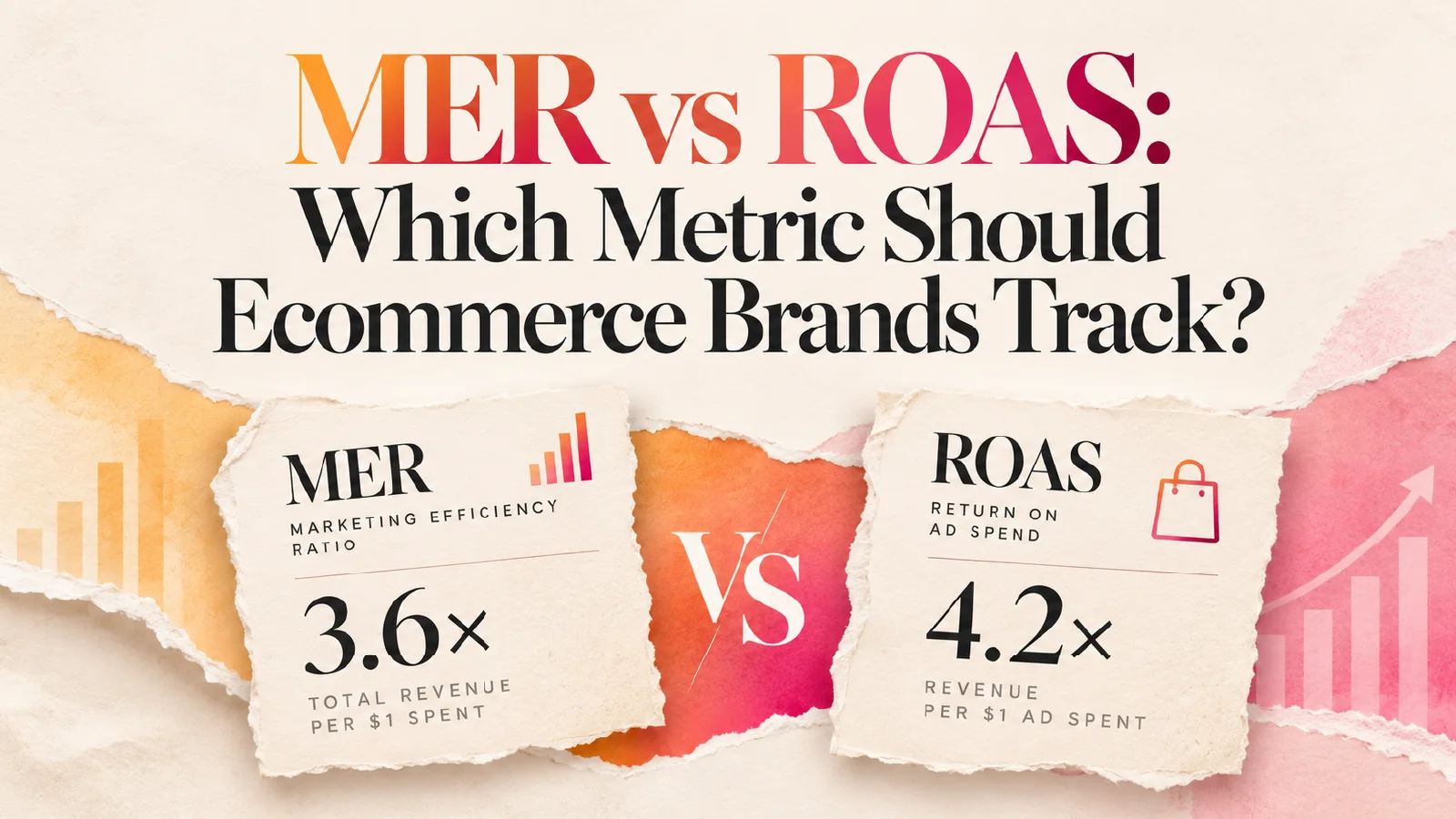
MER, or Marketing Efficiency Ratio, gives ecommerce brands a broader view of marketing performance by comparing revenue with marketing spend. ROAS, or Return on Ad Spend, focuses more specifically on the revenue attributed to advertising compared with the amount spent on those ads. Both metrics can be useful, but they answer different questions.
Understanding the difference between MER vs ROAS is important because relying on only one of them can make it harder to understand what is actually happening across your marketing.
What Is ROAS?
ROAS stands for Return on Ad Spend. It measures how much revenue is attributed to advertising for every dollar spent on ads.
The basic ROAS formula is:
ROAS = Revenue Attributed to Ads ÷ Ad Spend
For example, imagine you spend $10,000 on Meta Ads and the platform attributes $40,000 in revenue to those ads. Your reported ROAS would be 4.0, or 4:1.
That means the platform is reporting $4 in attributed revenue for every $1 spent on advertising.
ROAS is particularly useful when you want to analyze individual advertising channels, campaigns, ad sets, or ads. It can help you compare different campaigns, identify where ad spend is producing attributed revenue, and make decisions about creative, targeting, bidding, and budget allocation.
However, there is an important limitation. ROAS depends on attribution. The revenue reported by an advertising platform is based on the attribution settings and tracking available to that platform. Different platforms can therefore claim credit for the same customer journey or report different amounts of attributed revenue. (Shopify)
This does not make ROAS useless. It simply means that ROAS should be understood as a measurement of attributed advertising performance, rather than a complete measurement of the business.
What Is MER?
MER stands for Marketing Efficiency Ratio. It is designed to give you a broader view of how efficiently your marketing investment is generating revenue.
A commonly used formula is:
MER = Total Revenue ÷ Total Marketing Spend
For example, if an ecommerce brand generates $200,000 in revenue and spends $50,000 on marketing, its MER is 4.0.
In simple terms, the business generated $4 in revenue for every $1 included in its marketing spend.
The important difference is the scope of the calculation. MER is generally designed to look at the business as a whole rather than asking which specific advertising campaign received credit for a sale.
Depending on how a company defines marketing spend, MER may include paid advertising, influencer costs, creative production, agencies, marketing software, and other marketing expenses. Some businesses use a narrower definition and include primarily media spend. The key is to define the calculation consistently so that the metric remains useful over time. (Shopify)
This broader perspective is what makes MER particularly useful for ecommerce brands that have multiple acquisition and retention channels.
MER vs ROAS: What Is the Difference?
The simplest way to understand MER vs ROAS is to think about the question each metric is trying to answer.
ROAS asks:
“How much revenue did my advertising generate compared with what I spent on those ads?”
MER asks:
“How efficiently is my overall marketing investment generating revenue?”
ROAS is therefore more granular. MER is more holistic.
Imagine an ecommerce brand spends $20,000 on Meta, $10,000 on Google, and $5,000 on influencers. During the same period, the store generates $140,000 in revenue.
Meta might report a ROAS of 4.5. Google might report a ROAS of 5.0. The influencer program may be measured differently or may not have reliable direct attribution at all.
But if the brand looks at its overall marketing spend, it can calculate a broader efficiency metric based on the revenue generated and the spend included in its MER definition.
This is the fundamental difference. ROAS breaks performance down by advertising activity. MER looks at the relationship between the business’s revenue and its broader marketing investment.
Why ROAS Can Look Better Than the Business Feels
One of the most common problems with relying too heavily on platform ROAS is that the numbers can look strong while the overall business performance does not improve at the same rate.
Suppose Meta reports a 5.0 ROAS. At first glance, that sounds strong. But that number does not necessarily mean that the business generated five dollars of incremental profit for every dollar spent.
The calculation does not automatically account for product costs, shipping, returns, discounts, agency fees, creative production, software, salaries, or other business expenses.
It also does not necessarily tell you whether Meta was responsible for the entire customer journey. A customer might discover your brand through social media, search for it later, return directly to your website, and then complete a purchase. Different systems can assign credit to different touchpoints.
This is one reason why platform ROAS and business-level metrics can tell different stories.
A high ROAS on one platform does not automatically mean the entire marketing system is becoming more efficient. Likewise, a lower platform ROAS does not automatically mean that a channel has no value. The surrounding customer journey and the way revenue is attributed matter.
Why MER Gives You a Different Perspective
MER removes much of the channel-level attribution question by looking at revenue and marketing spend at a broader level.
If your store generates $500,000 in revenue and you spend $100,000 on the marketing costs included in your calculation, your MER is 5.0.
That number does not tell you whether Meta, Google, email, influencers, organic search, or another channel generated each individual order.
That is precisely why it can be useful.
Instead of asking which platform claims the sale, you are asking whether the total marketing investment is producing enough revenue for the business.
This makes MER particularly useful when your ecommerce marketing becomes more complex. As you add channels, campaigns, creators, email, SEO, branded search, retargeting, and retention activity, attribution becomes harder to interpret in isolation.
MER gives you a consistent business-level number that you can monitor over time.
Is MER the Same as Blended ROAS?
This is where ecommerce terminology can become confusing.
MER and blended ROAS can be very similar, and in some cases they can be mathematically identical.
For example, if you calculate:
Total Revenue ÷ Total Ad Spend
you may describe that number as blended ROAS.
If you calculate:
Total Revenue ÷ Total Marketing Spend
you may describe it as MER.
If your definition of marketing spend only includes advertising spend, the two calculations can produce exactly the same number.
The difference is therefore not always the formula itself. It is often the scope of the denominator and the way the metric is being used.
This is why ecommerce teams should define their metrics clearly rather than assuming that everyone means the same thing when they say “MER” or “blended ROAS.” Shopify also describes MER as a blended metric and notes that businesses may define marketing spend differently depending on what they want the metric to capture. (Shopify)
A Simple Shopify Example
Let’s say your Shopify store generates $300,000 in revenue in one month.
During that month, you spend:
$50,000 on Meta Ads
$25,000 on Google Ads
$10,000 on TikTok Ads
$15,000 on influencers and creative production
Your total marketing spend is $100,000.
Your MER would therefore be:
$300,000 ÷ $100,000 = 3.0
The business generated $3 in revenue for every $1 included in its marketing spend.
Now imagine Meta reports $160,000 in attributed revenue from its $50,000 spend.
Your Meta ROAS would be:
$160,000 ÷ $50,000 = 3.2
Google might report $100,000 in attributed revenue from its $25,000 spend, giving you a ROAS of 4.0.
These numbers are not necessarily contradictory.
Meta ROAS tells you about Meta’s attributed advertising performance. Google ROAS tells you about Google’s attributed advertising performance. MER tells you about the relationship between total revenue and the marketing spend included in your calculation.
Each metric is looking at the business from a different angle.
Which Metric Should Ecommerce Brands Track?
The better question is usually not whether you should track MER or ROAS.
You should track both.
ROAS is useful when you are operating inside your advertising accounts and making channel-level decisions. If you want to know which campaigns are generating the strongest attributed return, ROAS gives you a useful framework.
MER is useful when you step back and ask whether the entire marketing system is working efficiently.
For example, a performance marketer may look at ROAS when deciding how to adjust Meta campaign budgets. A growth lead may look at MER when evaluating whether total marketing investment is producing enough revenue to justify continued spending.
The two metrics work at different levels.
ROAS helps you zoom in.
MER helps you zoom out.
When Should You Use ROAS?
ROAS is particularly useful for campaign and channel analysis.
If you are comparing two Meta campaigns, ROAS can help you understand which campaign is generating more attributed revenue relative to its spend.
If you are evaluating Google Ads, ROAS can help you assess performance at the campaign, product, or account level.
It can also be useful for identifying changes in advertising efficiency. If ROAS falls significantly while spend increases, that may be a signal to investigate targeting, creative, landing pages, product mix, conversion rate, attribution, or audience saturation.
The important point is that ROAS should be interpreted within the context of the platform and attribution model being used.
When Should You Use MER?
MER becomes more useful when you are looking at the overall business.
It can help answer questions such as:
Is revenue growing faster than marketing spend?
Is increasing the marketing budget improving overall efficiency?
Did our total marketing investment become more or less efficient this month?
Are we scaling revenue without increasing marketing spend at the same rate?
Did a change in our channel mix affect overall marketing efficiency?
These are business-level questions, and MER is designed to provide a simpler way to monitor them.
MER can also be particularly useful for brands where not every marketing activity has clean attribution. Organic traffic, word of mouth, branded demand, repeat customers, influencers, email, and direct traffic can all contribute to revenue without fitting neatly into a single advertising platform.
Why You Should Not Treat MER or ROAS as Profitability
One of the biggest mistakes ecommerce brands make is treating ROAS or MER as a direct measure of profit.
Neither metric tells you how much money the business actually keeps.
Imagine two brands both have a ROAS of 3.0.
Brand A sells products with high gross margins.
Brand B sells products with much lower margins and has significant fulfillment, return, and operational costs.
The same ROAS can have very different economic implications for those two businesses.
The same applies to MER.
A MER of 4.0 does not automatically mean that the business is profitable. You still need to understand gross margin, contribution margin, fulfillment costs, discounts, returns, payment fees, customer acquisition costs, and other relevant expenses.
This is why the right way to use these metrics is as part of a larger measurement system rather than as a single number that determines whether marketing is working.
The Problem With Chasing a Single Number
A common ecommerce habit is to set a ROAS target and optimize everything around it.
For example, a brand might decide that every campaign must maintain a 4.0 ROAS.
The problem is that this can encourage teams to protect short-term attributed efficiency instead of understanding the broader growth picture.
A retargeting campaign might produce a very high ROAS because it reaches people who already know the brand. A prospecting campaign may produce a lower ROAS while introducing the brand to new customers.
Looking only at the reported ROAS can make these two activities appear directly comparable when they may have very different roles in the customer journey.
MER provides another layer of context because it focuses on the relationship between overall revenue and marketing investment.
The goal is not to replace ROAS with MER. It is to avoid making important business decisions from a single metric.
How to Use MER and ROAS Together
A practical ecommerce measurement system can start with MER at the business level and then use ROAS to investigate what is happening inside individual channels.
For example, imagine your MER drops from 4.0 to 3.2.
That tells you something changed in the overall relationship between revenue and marketing spend.
You can then move into your channel-level metrics.
Did Meta ROAS decline?
Did Google ROAS decline?
Did spend increase faster than revenue?
Did your product mix change?
Did average order value fall?
Did conversion rate change?
Did customer acquisition become more expensive?
Did you increase spending on channels that have a longer conversion cycle?
This creates a more useful measurement hierarchy.
MER tells you that something happened at the business level. ROAS and other channel metrics help you investigate where and why it happened.
What Ecommerce Brands Should Actually Monitor
MER and ROAS should sit alongside other ecommerce metrics rather than replacing them.
Revenue tells you how much the business generated.
MER tells you how revenue compares with your defined marketing investment.
ROAS tells you how individual advertising activities are performing based on attributed revenue.
CAC tells you how much it costs to acquire customers.
Conversion rate tells you how effectively traffic turns into purchases.
Average order value tells you how much customers spend per order.
Customer lifetime value helps you understand the longer-term economic value of customers.
Contribution margin helps connect revenue and acquisition performance to the economics of the business.
Together, these metrics provide a much more useful picture than any single dashboard number.
The Bottom Line on MER vs ROAS
MER and ROAS are not competing metrics. They are different ways of looking at marketing performance.
ROAS is closer to the advertising account. It helps you understand how much revenue is being attributed to specific advertising activity relative to the spend behind it.
MER is closer to the business. It helps you understand how total revenue relates to the marketing investment included in your calculation.
For ecommerce brands, the most useful approach is often to use both.
Track MER to understand the overall direction of marketing efficiency. Track ROAS to understand what is happening inside individual channels and campaigns. Then use revenue, margin, CAC, conversion rate, AOV, and customer behavior to understand whether those marketing results are translating into sustainable business performance.
The real goal is not to find one perfect metric. It is to connect the numbers so that you can see what is actually driving revenue.
How Adpie Helps Connect MER and ROAS
Looking at MER and ROAS separately can leave you with the same problem ecommerce teams have with many marketing dashboards: plenty of numbers, but not enough context.
Adpie connects Meta, Google, and TikTok performance with Shopify store data so you can compare advertising performance with what is actually happening in your store.
Instead of looking only at platform-reported ROAS, you can bring channel performance and store revenue into the same picture. This makes it easier to understand where attributed performance is coming from, where the numbers diverge, and what deserves a closer look.
For ecommerce brands, the goal is not simply to report another ROAS number. It is to understand which marketing activity is contributing to revenue and how efficiently the overall system is working.
That is the difference between tracking marketing metrics and actually using them to understand your business.